



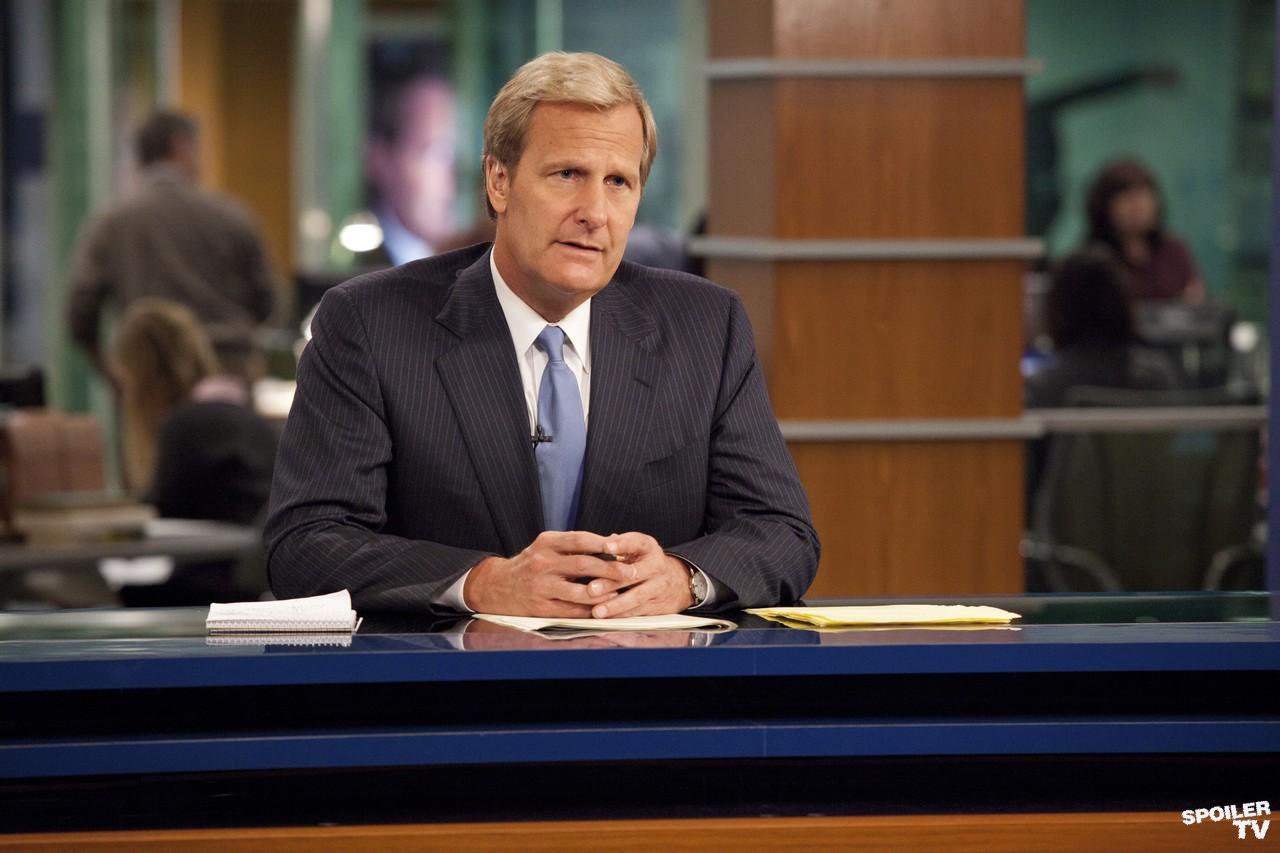
Source: SpoilerTV
I’m not much of an Aaron Sorkin follower, or believer for that matter. In fact, I had no real clue who the man was before I watched Studio 60 on the Sunset Strip (which was widely panned by critics, for the most part, and was a ratings failure). Only after watching the entire series (consisting of one 22-episode season)—and expressing my love for it—earlier this year did someone tell me that it was obviously going to be good because it was created by Aaron Sorkin.
Whoops. I think I need to apologize right here and now for never having watched The West Wing. Or worse: not having the desire to, either. But I can say this with confidence: I absolutely loved The Social Network and I also loved Studio 60.
And The Newsroom is, in part, somewhat like Studio 60. I think, perhaps, there’s a bit more dimensionality to Newsroom than the latter, but all of the elements are in play. Someone with a lot of American broadcast cachet boils to the point of eruption and people are around to film it. Cue the revamp of current stasis (what was previously a sketch comedy show is now a one hour news show). There’s an ambivalent, but mostly friendly, studio boss. There’s a return of an old flame to one half of that pairing’s job. There’s drinking; there might be drugs — who knows? There’s the conservative one. There’s the minority. It’s all a bit familiar.
And, yet, it feels new in its own right. So what if elements of past series are used in new ones? I suppose it would matter if every series felt like the same carbon copy, but they don’t. That’s just the thing. The Newsroom is…well, new. It feels new. There’s an entirely different monster for these guys to tackle.
The series follows Will McAvoy, a news anchor, who has just for the first time ever spoken his opinion about American government and politics. Soon thereafter: his entire news staff decides to leave for another show at the network, and Will finds he needs to hire a new Executive Producer (and staff). Well, actually, she’s already hired — without Will’s consent — and they have history. So now, new EP Mackenzie wants to revamp the show to…well, I don’t know…something. Mackenzie doesn’t want to make Will a news pundit of any kind; she just wants to make it different than it was (and for what it’s worth, it appears that Will’s old show was basically just bland, but had huge ratings).
There’s always been a great debate about our news anchors and reporters: should they have bias? should they be opinionated? shouldn’t they just report facts? Obviously, every anchor and reporter has biases. But no, personally, no reporter should ever show a bias towards what they’re reporting. Sometimes I even grind my teeth when I hear a news anchor mention that a news story was “Sad, wasn’t it?” or “That’s just very heartfelt, right there.” Anchors and reporters should be like robots that relay information and nothing more.
But what matters here is the substance of that information. How deep into his journalistic duties is Will willing to go? The pilot episode deals with the BP oil spill of 2010, and I think there’s a scene that very much helps exemplify how the show is differentiating itself from the great debate. The news team wants a statement from BP — and they get it, but all it says is their prayers go out to the families involved in the tragedy. And that’s great, and it’s true, and it’s a tragic event — but Will laughs. Because yes obviously people died and it’s saddening, but that’s not the story and their statement boils down to bullshit PR. They don’t comment one bit about the causes for the spill, or the explosion. Should he chuckle? That chuckle right there implies that the statement is lesser than, and ultimately news shows form the American people’s conversation. Should he just have read it, and let the audience decide if it’s bullshit on their own?
Unfortunately, that would be thinking too critically about the series. And I think that’s where critics and journalists all around the web got confused. This, to me, seems like a series about the machine that is a newsroom (and if it’s like Studio 60, the interpersonal relationships as well). It’s not about the journalistic integrity (though perhaps it could be down the line). And for that, it’s great at what it does. In fact, the pilot episode veers into the acme of its own greatness during the last half hour or so when the news show is counting down to being on air, everything that happens between then and the credits rolling is at its highest potential. That’s when this show exceeds, more so than what came prior.
Though, to be fair, what comes prior is somewhat low key because no one’s in the office.
There are lingering storylines, of course, mostly romantic. And I think we’re supposed to care for them. And we do; the characters are fleshed out well enough for the first episode without ever leaving the one set. (Seriously, that’s really good writing.) But if I’m being honest, the adrenaline of the live show is somewhat what makes the show. That said, I suspect the relationships in the office will captivate me like Studio 60 did, and I’ll cease to wait for the “on air” moments of the episodes as I did with that show as well. And for that, I very much intend on watching. And for that, I say this was a fantastic pilot episode — maybe one of the most well-rounded, well-produced of the year thus far.
So who cares if Sorkin is using his characters to voice his own ideologies (he has vehemently stated he’s not doing that…though it seems like he is)? So what if the show is set in the past (seriously, why was this ever a freakin’ criticism?)? Believing that any of this would affect the audience’s own views of their own lifestyles anymore than a “news” show by some extremely conservative/liberal pundit would be ignoring this series’ own argument entirely. And it would be giving it too much credit.
I guess in that way, The Newsroom is the most meta show on air right now.
If you couldn’t catch The Newsroom or just don’t have HBO, the entire first episode was made available on YouTube.
- Get more
- The Newsroom
- Recaps

Michael loves TV. You can find him at home, where he spends all of his time watching TV with his best friends couch and cable access.